The Reign of Violent Rain
The Greatest Threats of Climate Change Have Become Reality
Infectious disease vectors, violent rain, and deadly humid heat now stand among the greatest threats of climate change, no longer future warnings but present realities. This deadly triad -- rising infectious diseases, escalating heat extremes, and intense rainfall events -- has begun driving an exponential increase in climate-related deaths worldwide. These hazards do not operate in isolation; they amplify one another's impacts, creating cascading risks that strain health systems, destabilize communities, and accelerate global mortality. Climate change has become a full-scale health crisis, demanding urgent, systemic action before these accelerating threats overwhelm society's ability to respond.
What is Violent Rain?
Many people equate "global warming" solely with an increase in heat. This is a deadly mistake. The additional energy in our climate system does not remain simply as heat; it manifests in many forms, with great weight and gravity -- most notably in the intensification of extreme weather events, including violent rain.
Multiple factors drive the physics of violent rain, starting with the moisture content of the air.
As the Earth warms, warmer air can physically hold more water than cooler air. For every 1°C (1.8°F) increase in temperature, the atmosphere can hold about 7% more moisture, increasing the potential for heavy rainfall. Over a 10°C increase, this capacity nearly doubles, amplifying the intensity and frequency of extreme rain events.
One physical result of warming is the formation of larger raindrops, as well as an increase in the number of raindrops falling per square foot. Momentum of Rain is defined by the equation p = mv (where p = momentum, m = mass, and v = velocity). As raindrop mass increases, so does momentum, and part of this increasing momentum transfers to the air, intensifying wind turbulence and updrafts. Most momentum, however, is transferred upon impact, which you may notice as rain bouncing higher off streets and sidewalks. Flowing rainwater will also carry greater mass and velocity, increasing the destructive power of runoff.
On the ground, concrete, asphalt, solar panels, roofs, plants, animals, homes, and infrastructure are all struck with greater force as rain momentum rises.
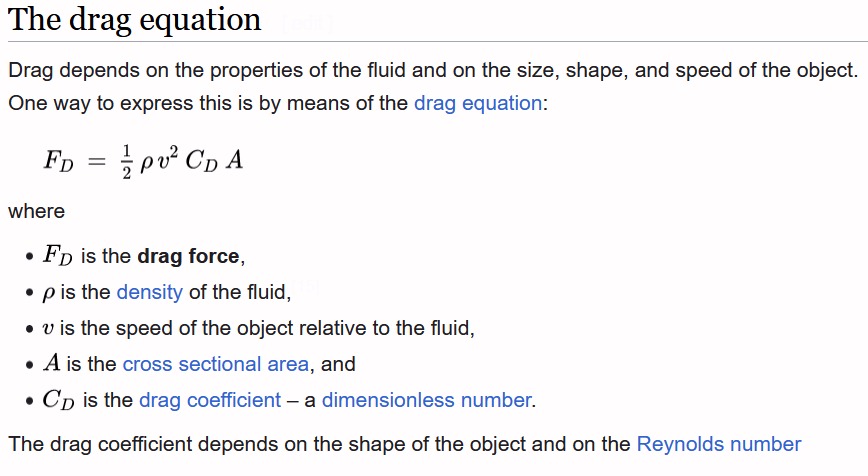
Mass and velocity are part of a larger equation that includes density. Together, these variables increase the intensity of flow forces (flow dynamics). Wind and water flow forces scale with the square of velocity (v²). As flow speeds increase -- due to heavier rain or more intense heating -- damage scales as the square of that increase.
According to drag physics, force is proportional to density multiplied by the square of velocity (v²). For example:
- A 20 mph wind exerts 4 times the force of a 10 mph wind.
- A 40 mph wind exerts 16 times the force of a 10 mph wind.
- A 50 mph wind exerts 25 times the force of a 10 mph wind.
- A 60 mph wind exerts 36 times the force of a 10 mph wind.
Density further multiplies this force. Water is about 800 times denser than air, so a 10 mph flow of water exerts 800 times the force of a 10 mph wind. As flow velocities increase due to climate change, the resulting forces and damage scale exponentially. While the exact rate of velocity increases with climate change remains under study, we are already seeing the impacts as flood systems fail, sewage systems overflow, and hillsides collapse under the amplified force of violent rain and runoff.
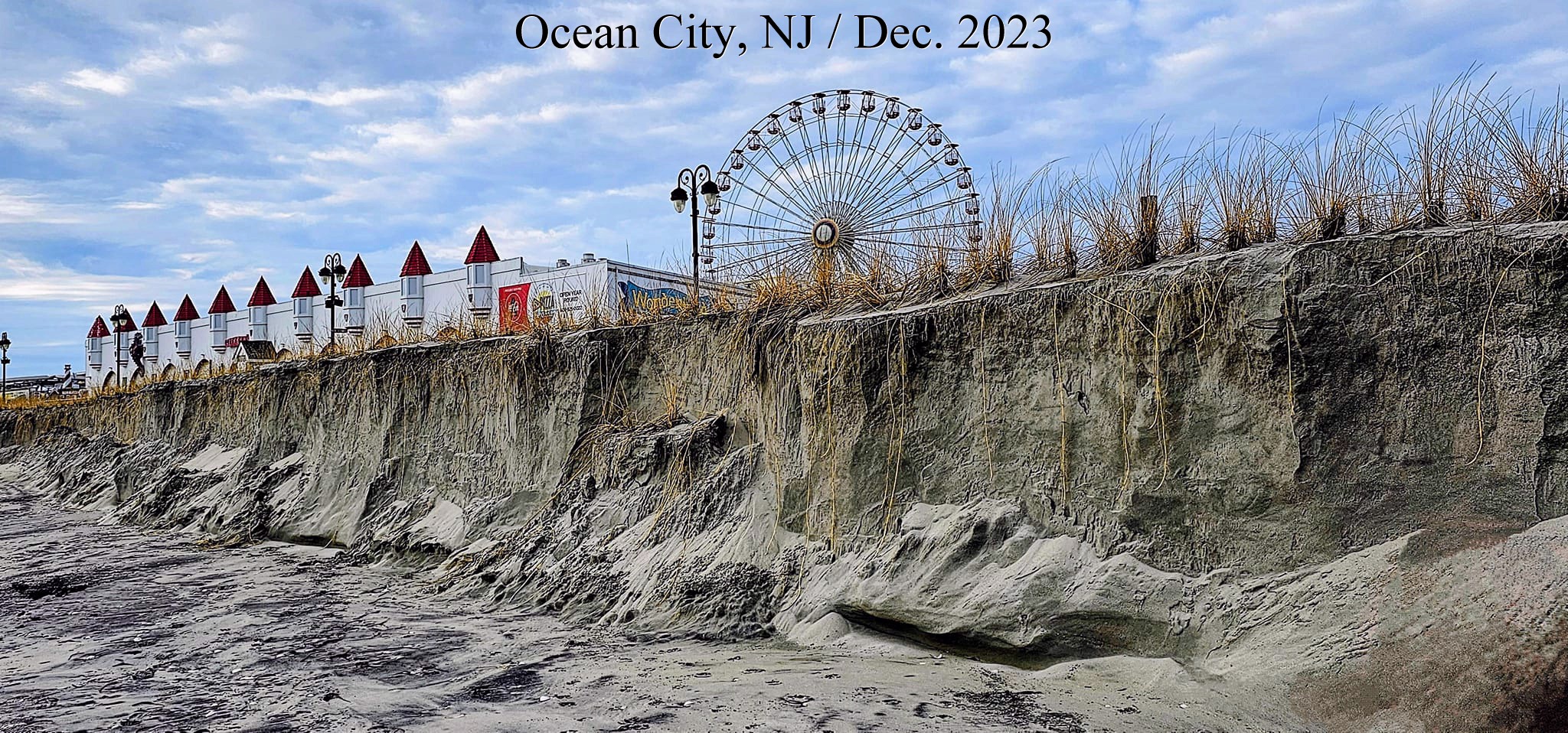
You can imagine Eastern and Western North America as vast beaches with increasingly frequent atmospheric waves crashing down upon us. The Gulf Coast, in particular, will face impacts from both directions.
Atmospheric Rivers
As the Earth warms, the air will hold more moisture. More moisture-laden air moves over land and creates atmospheric rivers (e.g. The Pineapple Express). The Journal EOS in the article Atmospheric Rivers Spur High-Tide Floods on U.S. West Coast said, "Atmospheric rivers are narrow bands of moisture that travel across the lower troposphere, generally at the leading edges of massive low-pressure systems. At their peak, they can carry as much water through the sky as the Amazon River does on land. They unleash intense winds and heavy rain as they surge across the Pacific Ocean, eventually making landfall on the U.S. West Coast, contributing to many high-tide flooding events."
The atmospheric rivers also bring heavy rainfall inland causing extreme flooding. In October of 2021 NOAA said, "a convergence of storms brought more than half a foot of rain to parts of the Bay area in addition to strong winds, flash floods, and mud/landslides. They also bring the potential for heavy snow to higher elevations in the Sierra Nevada mountain range."
In March 2024, NOAA and the National Weather Service finally recognized the heightened frequency of East Coast Atmospheric Rivers occurrences, attributing them primarily to the recent shifts in the Pacific/North America (PNA) teleconnection pattern. This shift is accompanied by a northward movement of the midlatitude jet stream.
The Philadelphia Violent Rain Experiment
The Greater Philadelphia Area serves as our focal point for studying non-coastal violent rain events. Although situated 78 miles from the nearest coast, Philadelphia has experienced a surge in violent rainstorms since 2021, with each episode yielding more precipitation than the typical monthly average. In addition to enduring Nor'easters and tropical storms from the Southeast, Philadelphia is increasingly subjected to deluges originating from the Gulf of Mexico.
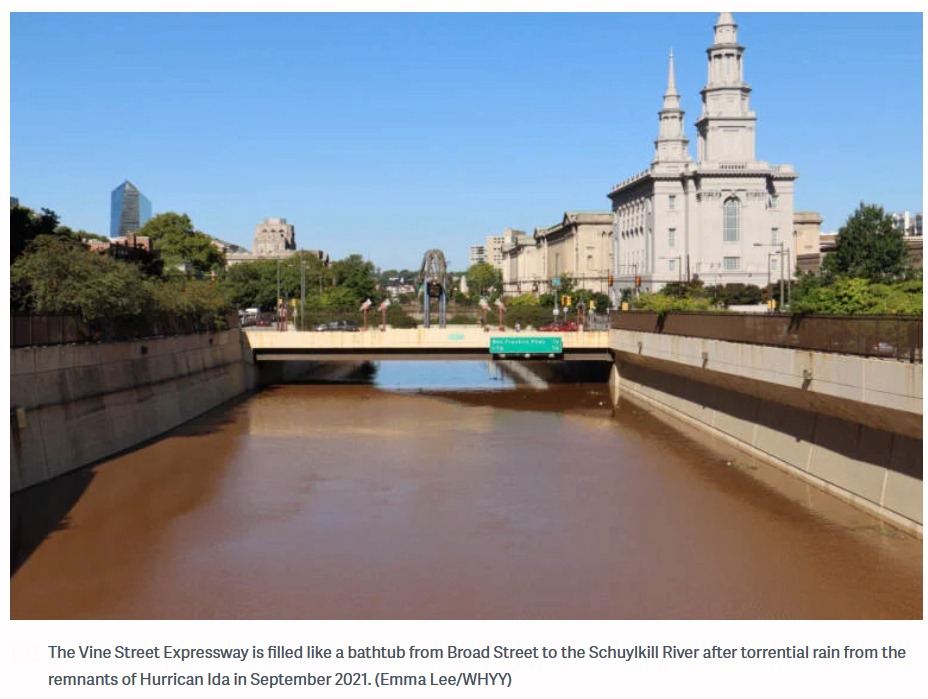
Hurricane Ida in the summer of 2021 is a good example. Because of the 85 degrees Fahrenheit Gulf of Mexico ocean temperature, Ida rapidly gained strength right before it made landfall jumping from a Category 1 to a Category 4 storm. The warm air allowed more moisture to be carried as rain. The storm was so large that it was able to pick up more moisture from the Atlantic Ocean. After destroying parts of Florida, the ocean moisture was carried inland and dumped over places like Pennsylvania and New York. Ida caused record flood damage in parts of Pennsylvania. The Philadelphia Inquirer reported, "The remnants of Hurricane Ida destroyed or damaged hundreds of homes in Southeastern Pennsylvania and caused more than $100 million in public infrastructure damage across the state." There were more deaths in the Northeastern USA than where the storm made landfall in Louisiana. The New York Times reported, "The remnants of Hurricane Ida caused flash flooding and a number of deaths and disrupted transit across parts of New York and New Jersey. The storm killed at least 43 people in New York, New Jersey, Pennsylvania and Connecticut and left more than 150,000 homes without power." Ida's Philadelphia area destruction included 5 deaths, 7 tornadoes, record flooding, hundreds of water rescues, and "one incredibly soggy mess." The violent rain in Philadelphia was so extreme that the main road across the city from the Delaware River to the Schuylkill River, the Vine Street Expressway, was turned into a canal. "You could've swam from 22nd Street to about 15th Street," said Justin Galbreath, a district maintenance manager at the Pennsylvania Department of Transportation. As climate change intensifies, the frequency of Vine Street becoming a river will likely increase until such time as it becomes permanent.
The train derailment in Plymouth Meeting (July 17, 2023), the eleven vehicles swept away, and the seven people drowned by flood waters in Washington Crossing (July 15, 2023) were caused by a deluge of rain and flash flooding. "In my 44 years, I've never seen anything like it," Upper Makefield Fire Chief Tim Brewer said. "When the water came up, it came up very swiftly. We do not think that anybody drove into it, that they were actively on that road when it happened." CBS news reported, "Over 6 inches of rain in an hour caused the flash flooding according to Brewer. The fire department was dispatched in that area for a lightning strike and just by happenstance they found 11 cars. Eight people were rescued from the cars and two from the creek." In July and December of 2023, extreme rainfall resulted in sinkholes being exposed in the carbonate rock under Route 202 in nearby King of Prussia, PA.
In September of 2023, the Philadelphia Inquirer reported, "The remnants of Tropical Storm Ophelia soaked the entire Philadelphia region with episodic downpours on Saturday, the first day of fall, conspiring to incite 60-mph wind gusts at the Shore and high-tide flooding that closed numerous roads in beach and back-bay towns." There were up to 8 inches of rain recorded throughout the Philadelphia region over the three day event.
The winter of 2023 saw near weekly atmospheric river flash flooding events. On January 9, the Greater Philadelphia Region incurred an historic winter tropical violent rain event. CBS news reported, "If it feels like it's been an abnormally rainy few weeks, you're right. Normal rainfall totals between Dec. 1 and Jan. 9 amount to about 4.78 inches. Between December 2023 and Tuesday, we'd already recorded more than 9 inches of rain, an amount normally recorded in December, January and February combined." The January 9 storm brought over 4 inches of rain to many areas. The Delaware River peaked at its highest level ever. There were hurricane strength winds with wind gusts over 70mph.
On March 23, 2024, Philadelphia witnessed its wettest March day on record. The rain gauge at the airport measured over 3 inches of rainfall, with parts of New Castle County, Delaware, also receiving over 3 inches. Some areas in Gloucester County and Camden County, New Jersey, recorded rainfall exceeding 4 inches. The precipitation observed on that day was roughly equivalent to the typical rainfall for the entire month. A young girl was swept away by the rapidly rising and swift moving waters of the Chester Creek in Delaware County, PA. On the same day, an atmospheric river event brought heavy rains to Brazil's Rio de Janeiro state, resulting in at least nine fatalities, with Petropolis being the hardest hit. A staggering 270 mm (11 inches) of rain fell within 24 hours, significantly impacting the region and leading to numerous incidents, including landslides and house collapses.
Between April 1 and 4, 2024, Southeastern Pennsylvania experienced another severe weather event attributed to atmospheric rivers and strong winds. Rainfall accumulation exceeded 3 inches, accompanied by wind gusts ranging from 35 to 45 mph. Tragically, two individuals lost their lives in unrelated incidents, one in Montgomery County and the other in Delaware County, when trees collapsed onto their vehicles. Blue Marsh State Park had to shut down when the lake unexpectedly rose by nine feet overnight.
Conclusion
Humans are making the Earth hotter. The cool water from the melting ice at the poles is being drawn toward the center of the Earth and getting warmed to record high temperatures. The warm, moist air is circulating and moving over land. The average time moisture stays in the air is 9 days before it turns into precipitation. The warmer the air becomes, the more rain the atmosphere holds and dumps; therefore, violent rain events are increasing in frequency and intensity.
The greatest short term risk to the Earth is violent rain (liquefied water vapor). The greatest short term risk to human health is deadly humid heat (hot water vapor).
* Our climate model employs chaos theory to comprehensively consider human impacts and projects a potential global average temperature increase of 9℃ above pre-industrial levels.
Tipping points and feedback loops drive the acceleration of climate change. When one tipping point is breached and triggers others, the cascading collapse is known as the Domino Effect.
What Can I Do?
There are numerous actions you can take to contribute to saving the planet. Each person bears the responsibility to minimize pollution, discontinue the use of fossil fuels, reduce consumption, and foster a culture of love and care. Be a butterfly and affect the world. The Butterfly Effect illustrates that a small change in one area can lead to significant alterations in conditions anywhere on the globe. Hence, the frequently heard statement that a butterfly in China can cause a hurricane in the Atlantic.