Overview: The Delaware Valley Under Climate Stress
The Greater Philadelphia region sits at the intersection of coastal influence, river systems, aging infrastructure, and accelerating atmospheric change.
Since 2021, the Delaware Valley has experienced a marked rise in high-intensity rainfall events — storms that produce a month’s worth of precipitation in hours. These events strain infrastructure, threaten public safety, and expose systemic vulnerabilities.
- Violent Rain: Increased atmospheric moisture is producing heavier downpours and flash flooding. Violent rain events are becoming more frequent and more destructive.
- Social-Ecological Systems: Biogeophysical processes can be modeled; socio-economic systems introduce cascading, unintended consequences.
- Sea Level Rise: Higher baseline water levels increase flood risk along the Delaware River.
- Urban Heat Island: Rising temperatures intensify heat stress in dense neighborhoods.
- Agriculture & Ecosystems: Changing precipitation and temperature patterns disrupt yields and biodiversity.
- Public Health: Heat illness, respiratory stress, and vector-borne disease risks increase.
- Infrastructure Risk: Roads, bridges, stormwater systems, and drinking water infrastructure face compounding stress.
Where the Schuylkill Meets the Delaware
The river confluence in Philadelphia is increasingly vulnerable to tidal flooding and saltwater intrusion.
- Coastal Influence: Ocean tides and storm surge propagate upriver.
- Low Elevation: Portions of the city sit within flood-prone zones.
- River Constriction: Narrowing waterways amplify water levels.
- Impervious Surfaces: Urbanization reduces natural flood storage.
- Climate Change: Rising seas elevate baseline water levels.
Saltwater Intrusion
During the fall 2024 drought, the Delaware River Basin Commission released billions of gallons of upstream water to hold back the advancing salt front. Under normal conditions the salt front remains near mile marker 70. During drought it advanced to mile 89. Philadelphia’s drinking water intake sits at mile 110. In the 1960s drought, the salt front reached mile 102.
Saltwater intrusion threatens freshwater ecosystems, agricultural soils, infrastructure, and municipal water supplies. Once soils become saline, remediation is costly and slow.
The Violent Rain Pattern (2021–2024)
Although located 78 miles from the coast, Philadelphia has experienced repeated extreme rainfall events associated with hurricanes, nor’easters, atmospheric rivers, and Gulf-sourced moisture plumes.
Hurricane Ida (2021)
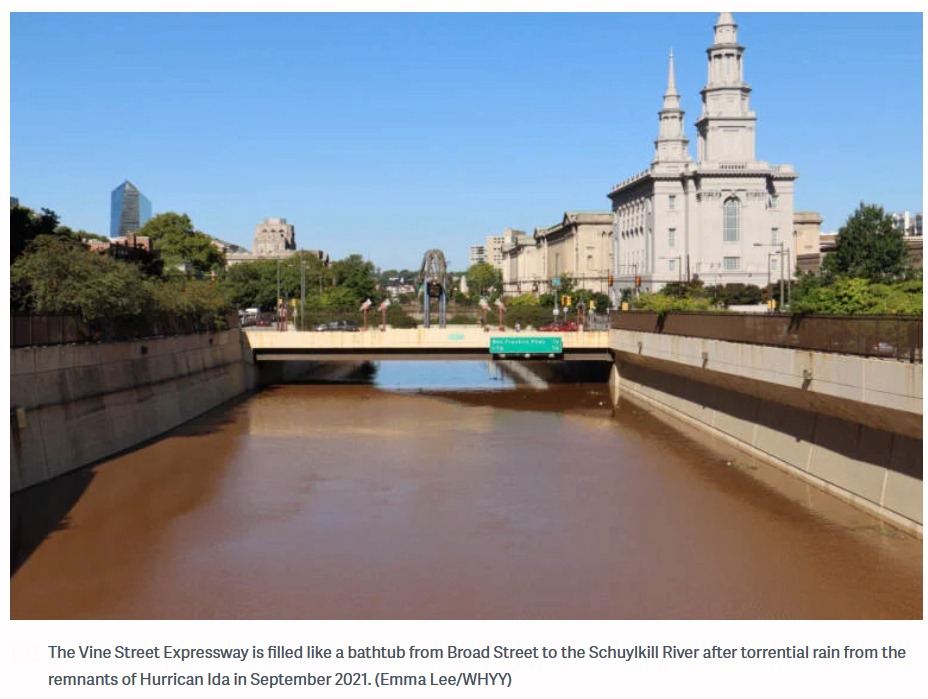
Rapid intensification over warm Gulf waters amplified moisture transport into the Northeast. The storm caused record flooding across Pennsylvania and multiple fatalities in the region. Vine Street Expressway became submerged, effectively transforming into a canal.
July 2023 Flash Flooding
Over 6 inches of rain fell within an hour in parts of Bucks County. Eleven vehicles were swept away. Multiple fatalities occurred. Extreme rainfall also exposed sinkholes in carbonate rock under Route 202.
Fall & Winter 2023–24
Successive atmospheric river events produced near-weekly flooding. Between December and early January, rainfall totals exceeded seasonal norms by more than double. Wind gusts surpassed 70 mph during the January 9 event. The Delaware River reached historic levels.
March 23, 2024
Wettest March day on record in Philadelphia. Over 3–4 inches fell across the region. A child was swept away in rapidly rising waters. The same atmospheric river pattern produced deadly flooding in Brazil.
April 1–4, 2024
Another multi-inch rainfall event combined with strong winds. Blue Marsh Lake rose nine feet overnight.
Conclusion
A warmer atmosphere holds more water vapor. For every 1°C increase in temperature, the atmosphere can hold approximately 7% more moisture. When that moisture condenses, rainfall intensity increases.
Violent rain — liquified water vapor — represents one of the most immediate climate risks to infrastructure and human life in the Delaware Valley.
The greatest short-term planetary risk is destabilized hydrology. The greatest short-term human health risk is deadly humid heat.
Our climate modeling framework integrates nonlinear feedbacks and chaotic system dynamics, projecting potential global temperature increases far beyond historical norms under unchecked emissions scenarios.